
by Linda Rawson | Jun 11, 2025 | Business
DynaGrace Enterprises is proud to be recognized on the 2025 Women Tech Council Shatter List, an honor that underscores its dedication to fostering diversity and inclusion in technology. This annual list highlights companies that actively foster opportunities for women in STEM, promoting leadership representation, mentorship, and equitable career growth.
Empowering Women in AI and Emerging Technologies
At DynaGrace Enterprises, we believe innovation flourishes when diverse perspectives are embraced. Led by Founder & CEO Linda Rawson and Vice President Jennifer Remund, DynaGrace combines AI-driven data science, autonomous sensor networks, and trusted AI systems with a culture of collaboration, empowerment, and strategic leadership.
Our team excels in data-driven intelligence, predictive analytics, and AI-enhanced decision-making, bridging both government and commercial applications while ensuring women have leading roles in these transformative fields.
What the Shatter List Means for DynaGrace
Making the Shatter List reinforces our commitment to:
✅ Hiring, mentoring, and elevating women in AI and data science
✅ Creating a workplace that champions innovation, inclusion, and leadership growth
✅ Expanding opportunities for women in government contracting and defense technology
✅ Pushing boundaries in AI-driven decision support systems
Looking Forward
This recognition is more than an award; it’s a testament to our ongoing mission. As AI and data science continue shaping industries, DynaGrace remains dedicated to ensuring women are at the forefront of innovation.
We invite others to join us in building a future where diversity drives progress.
Learn more about the Women Tech Council Shatter List here
Want to explore career opportunities with DynaGrace? Check out our employment page and connect with us to be part of the change!

by Dr. Jane Fitzgerald | Jun 17, 2023 | Business, Data Science
The Truth About Data Scientists.
Data science is the latest buzzword in the business sector. Everyone, from business professionals to beginners, is talking about it. Data science is one of the most popular and promising career paths for skilled and up-to-date professionals.
So, what the heck is data science in business?

Image Credit: Flickr
Traditionally, data science is researching, collecting/acquiring, and analyzing a vast volume of data, including data mining and data programming skills. Data scientists are skilled professionals that organize and analyze a vast amount of data for businesses/organizations.
Since the dawn of the 21st century, data science has evolved far beyond its traditional threshold. Rapid changes in modern business management with regards to the birth of the internet motivates organizations to uncover more useful information, stay competitive, and ensure customer satisfaction. Organizations must learn how to improve functions and optimize processes through data science. The only way data-scientists can make this possible is by mastering every stage, making up the data science life-cycle.
Five Stages of the Data Science Life-Cycle
Data scientists seeking to deliver results in an insightful, understandable, and compelling way must be efficiently skilled in every stage.
Technically, there are five stages in the life cycle, and these are:
Stage #1. Capture
Under this stage, data scientists must be vast and efficient in data acquisition/collection, professional in data entry, skilled in signal reception, and data extraction.
Stage #2. Maintain
Skill sets required for this stage include data warehousing, good knowledge of data cleansing, effective data staging, excellent data processing skills, and data architecture.
Stage #3. Process
At this stage, the data scientist initiates data mining, and then proceed to cluster/classification. The last two-know-how skills required in this stage are data modeling and data summarization.
Stage #4. Analyze
This phase requires extreme exploratory/confirmatory data analytic skills, and expertise in predictive analysis, solid regression skills, text mining, and superb qualitative analysis.
Stage #5. Communicate
Communication is the last stage of the life cycle. The skill sets the data scientist is expected to have here are;
a. Data reporting (vital to organizations in meeting their overall goals and objectives),
b. Data visualization (a roadmap for businesses module implementation), and lastly,
c. Business intelligence and decision making for an overall business drive.
How Does Data Science Impact a Business?
Businesses use data science to improve product quality and day-to-day operations diagnostically.
Data scientists with high-level technical skills help businesses identify vital questions and collect
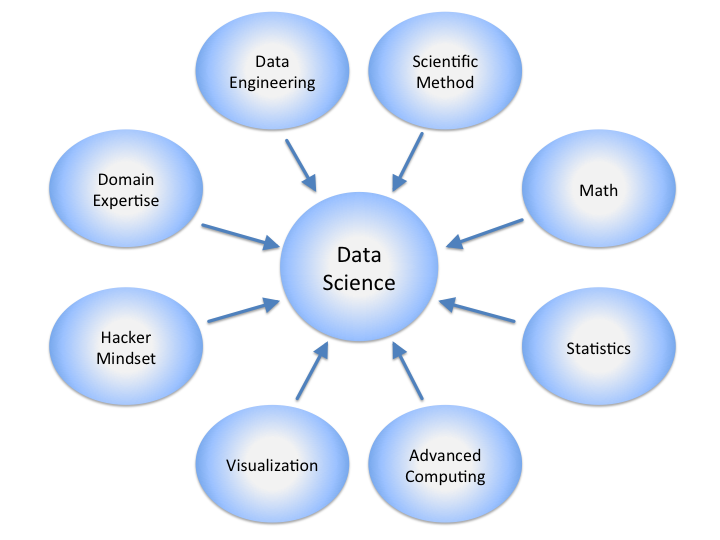
Image Credit: Wikimedia
data from multiple data sources. Next, they organize the information obtained, and translate the extracted results into actionable solutions, and communicate the same to management for positive business decisions.
These positive skills account for why data scientists have become prominent and sought after in all industries. Their ability to build and analyze algorithms with strong programming knowledge, quantitative skills in linear algebra and statistics, plus excellent communication skills makes them the knight in shining armor for any organization.
The vitality of data scientists in modern business practice cannot be overemphasized.
Data science and data scientists are a crucial aspect of every business setup in the 21st century. They do not just help businesses achieve their operational, strategic, and financial goals, but also help optimize acquisition, growth, and retention in customer success through the information it provides.
However, poorly utilized data science provokes huge financial loss in an organization.
Conclusion
Data scientists have the power to shape how organizations conduct business in line with customers’ changing needs and the rapid development of technology. There is a growing need for data scientists in the business sector. The job is ranked as the best profession in the United States for three consecutive years—2016-2018—and still growing. Also, the demand for experts in data science has increased by 28% in 2020, and from all indications, there is a sign of it slowing down soon.

by Dr. Jane Fitzgerald | Jun 17, 2023 | Artificial Intelligence, Emerging Technology, General, Information Technology
What is Artificial Intelligence (AI)?
Artificial intelligence (AI) is a computer-controlled entity’s ability to perform cognitive tasks and respond flexibly to

Image Credit: Piqsels.com
its environment to increase the probability of achieving a specific goal. The program can learn from data, from experience, and can mimic actions similar to human beings. But it does not generally use biologically measurable methods.
AI describes the computer’s ability to execute tasks to accomplish the desired objectives. It also means that a computer can effectively reduce or even eliminate human activities.
Popular examples of chess, go, and dota intelligence demonstrates computers in certain areas and outperform human capabilities. Natural language processing (NLP) and machine learning algorithms are currently the most known fields for AI.
Types of AI
- Artificial General Intelligence (AGI)
- Artificial Narrow Intelligence (ANI)
- Artificial Super Intelligence (ASI)
What is Artificial General Intelligence (AGI)?
AGI is still a concept of theory, recognized as Ai with a human-level cognitive capacity in a broad range of fields, including language processing, image processing, computational functioning, reasoning, etc.
We’re quite a long way from AGI system development. The AGI program will need to involve thousands of tandem-working artificial narrow systems that interact with one another to mimic human thought. Also, in advanced computing systems and facilities such as Fujitsu’s K or IBM ‘s Watson, a single second of neural activity simulates within 40 minutes. It applies to immense complexity and interconnections between the human brain and the scale of the task of constructing an AGI with the current resources.
What is Artificial Narrow Intelligence (ANI)?
ANI is the most popular type of AI on the market now. Such AI systems are designed to solve a single problem and can perform one function very well. They have limited capabilities by design, such as recommending a product for e-commerce users or weather prediction. It is today’s only form of artificial intelligence. They can approach human functioning in particular situations and, even in many cases, surpass it. But only in highly controlled environments with a limited range of parameters.
What is Artificial Super Intelligence (ASI)?
Here we are almost into science fiction, but ASI alias as the logical development of AGI. An Artificial Super Intelligence system (ASI) could exceed all human capacities; this will involve decision-making, sound decisions, and even issues like improving the art and developing interpersonal ties.
When Artificial General Intelligence succeeds, AI systems could quickly boost their ability and push into fields that we could not foresee. While the distance between AGI and ASI is relatively narrow (some say just like a nanosecond because that is how quickly Artificial Intelligence will learn), the long path to AGI itself looks like a dream far into the future.

Image Credit: Wikimedia
What is the Purpose of AI?
Artificial Intelligence aims to aid human performance and help us make high-level decisions with far-reaching consequences. That’s the response from a technical standpoint. From a philosophical viewpoint, Artificial Intelligence can help humans lead more fulfilling lives free of hard labor and help manage the vast network of interconnected individuals, businesses, states, and nations to work in a manner that’s beneficial to all humanity.
Currently, Artificial Intelligence aims to simplify human effort and to help us make better choices by all the different tools and techniques that we have invented. Artificial intelligence, similarly marketed as our Last Innovation was a development that would create breakthrough technologies and services. It would also transform our way of life exponentially and eventually eradicate conflict, injustice, and human stress.
That’s all in the far future, though – we’re quite a long way from those kinds of outcomes. At present, the primary purpose of AI is to improve companies’ process efficiency, automate resource-intensive tasks, and produce business predictions based on hard data rather than good feelings. As with other technology, companies and government agencies must finance research and development expenses before they are available to laypeople every day.
The application of AI?
AI is used in different fields to provide insights into user behavior and to provide data-based recommendations. For example, the predictive search algorithm used by Google previous user data to predict what a user would type in the search bar next. Netflix uses past user data to decide what movie a user wants to see next, link the user to the app, and maximize watch time. Facebook uses previous users ‘ data to automatically suggest tagging your friends based on their facial characteristics in their images. AI is used in large organizations to simplify the life of an end-user. In general, the applications of artificial intelligence will come under the category of data processing, including:
- Data filtering and search optimization to give the most relevant results
- Logical chains for if-then reasoning serves to execute command strings based on parameters.
- Pattern detection to recognize essential trends for useful insights in large datasets.
- Applied probabilistic models to predict future results
Why does it matter?
The Internet-enabled global communication for all and impressively changed our way of working, living, and interacting. With process automation, AI is supposed to do the same; this will affect the consumer sphere, but it will also influence more repetitive business processes or simple decisions.
Some of the effects most discussed would be autonomous driving, but analysis, customer service, regulation, legal, and management are fields in which AI can improve productivity significantly. This cross-industry influence makes it critical that nearly everyone participates in AI.
Where are we today?
Even though AI has been around for over 50 years, we are still in the early stages. Factors such as processing power, worldwide networking, and cloud technology have just begun to open up artificial intelligence opportunities.
With the large enterprise data sets available – massive data hype, the three main phases of artificial intelligence segments into pattern recognition. The second phase currently involves commercializing deep learning algorithms, which enable real learning systems through neuronal networks. There are still a few years of abstract and reasoning intelligence, but its development is now beginning.
First experiments already were undertaken, but business applications currently focus on phase two-giving technology plenty of room for performance and adoption.

by Anika D | Apr 5, 2023 | Emerging Technology
6G still needs to be technically available. However, according to experts, 6G is the next development in the world. This network is expected to take path-breaking technologies like edge computing and artificial intelligence to another level.
Moreover, 6G will also create an entirely new user experience. The sub-millimeter-sized radio or Terahertz waves can significantly lower latency and boost data speed to as high as 1 Tbps. It means the internet network can function at least a thousand times faster than the current Wi-Fi speed.

Source
The Growing Popularity of 6G Network
Interestingly, the top industry participants are adopting various approaches to 6G. Huawei, for example, likes to discuss 5.5G. According to the brand, the world cannot skip 5.5 G. After all it is the basic requirement for 6G.
It will allow transmitting other kinds of content and much more powerful solutions. Another objective is to cut network energy usage by a factor of ten.
Huawei also offered a sneak peek of some of its upcoming technological developments at the Mobile World Congress (MWC2023) in late February. The Chinese company showed how a logistics center can use a chip similar to the alarm tags on today’s product boxes to automate inventory control.
These chips are connected to a 5G network. They can instantly update inventories without any scanning process. The company feels optimistic that with these passive network-enabled devices, businesses can also offer automatic payment options to buyers.
Similarly, Sebastian Seung, the head of Samsung Research, also shared his views on the 6G network. He stated in May 2022 that 6G is critical to advancing the hyper-connectivity possibilities presented by 5G. 6 G is also essential to unlock new opportunities for extended reality, digital replicas, and holograms.
Samsung even established a new “6G Research Group” in October 2022, based on Seung’s conviction that the benefits of 6G would profoundly alter future mobile devices. Samsung is also a member of a new alliance that includes several technology suppliers and network carriers.
The “Next G Alliance,” established in 2022, was created with the goal of accelerating research into the 6G landscape and finding new network possibilities. It contains several important members. It includes the top four largest US mobile carriers – T-Mobile, Verizon, US Cellular, and AT&T. That’s not all.
This Alliance also includes many well-known brands like Meta, Microsoft, and Qualcomm. This brand seeks to bring together a diverse group of network carriers, telecommunications companies, and technology innovators. It aims to create new standards, technologies, and strategies for bringing 6G networks to the rest of the world.
Which Other Brands are Planning to Try a 6G Network?
In recent years, many other network carriers also have expressed their interest in the possibilities of 6G. Ericsson, a market leader in the telecom sector, has expressed their intentions to construct a new 6G research facility. According to the brand, the 6G network will begin to take off in the 2030s and introduce innovations for network security, green efficiency, and XR. It will also play a significant role in updating the top artificial trends of 2022.
Deutsche also demonstrated interest in the 6G landscape by launching the new German “NeXt” (Native Extensions for XR Technologies) research initiative. This initiative will create scalable solutions for the XR environment by introducing new technologies, software, and network connectivity options.

Source
6G and Transformation of Global Businesses
Businesses can sense the need for a 6G network by looking at the various applications developed today. For instance, 5G technology trends like virtualized networks are making way for 6G.
Operators have also increased their wireless network density by adding more aerials and antennas. It is now easier to obtain a high-speed internet signal, specially indoors. Through cloud technologies and edge computing, users now have direct access to data storage and processing. Even at scale, latency is significantly reduced.
AI is already being used in the 5G platform for optimization, dynamic resource distribution, and data processing. However, due to its incredibly low latency of less than one millisecond and distributed architecture, 6G will be capable of delivering worldwide integrated intelligence. The fourth industrial revolution will be propelled by 6G, which will be enabled primarily by industrial Internet of Things (IoT) services integrated with AI and machine learning.
6G wireless sensing solutions, such as threat detection, health monitoring, and air quality measurements, will affect government and industry approaches to public safety and vital asset protection. We can expect increased decision-making skills using real-time information, improving the responsiveness of law enforcement and first responders.
Immersive communication experiences will also be possible with 6G. Thanks to the location and context-aware digital services, sensory experiences like immersive extended reality (XR) and high-fidelity holograms. Look for augmented reality to replace virtual reality, which typically needs a bulky headset.
Many uses, including communication, telemedicine, architecture, interior design, and gaming, will incorporate holographic technology. Instead of today’s video conferences, users can communicate with others in real-time via virtual reality (VR), thanks to wearable sensors that simulate being in the same place.
Businesses also expect advances in precision healthcare. The 6G network will combine data science, analytics, and biomedicine to create a learning system. This combination helps conduct research in the context of clinical care while optimizing tools and information to provide better patient results. Precision healthcare could also entail using tiny nodes that monitor body functions linked to devices that can medicate and aid patients.
Moreover, the 6G network can also pave the way for massive construction industry growth. The lightning-fast speed of 6G will make 3D printing, prefabrication, and virtual reality possible. Moreover, these technologies will also make building projects more efficient, with less waste and shorter completion times.
6G will also increase safety in construction locations. Construction workers and engineers can be alerted instantly to any potential risks on a project by having access to real-time data from various sources. This will aid in lowering the risk of accidents and ensure all construction employees’ safety.
![Top 9 Career Profiles in Artificial Intelligence [Highly-Paid]](https://dynagrace.com/wp-content/uploads/2023/02/hitesh-choudhary-t1PaIbMTJIM-unsplash.jpg)
by Anika D | Feb 25, 2023 | Artificial Intelligence
The global Artificial Intelligence market is estimated at over $136 billion and rapidly changes how we work and live. As the field matures, AI jobs’ variety, quantity, and complexity will rise. It will open opportunities for a range of professionals, such as junior and senior researchers, statisticians, practitioners, experimental scientists, etc.
Lucrative job opportunities are also expanding along with the demand for AI experts. Here are the top nine Artificial Intelligence career paths that are making headlines in 2023.

Source
Computer Vision Engineer
Computer vision engineers mix machine learning and computer vision techniques to assist computers in understanding and interpreting visual data. They work closely with other programmers to develop systems that recognize and classify images from movies, photos, and other visual data.
This tech expert uses computer vision research to support the automation of predictive decision-making through visuals. They closely collaborate with object-oriented software to handle the processing and analysis of large data populations.
Data Scientists
For a variety of purposes, data scientists gather data, examine it, and draw conclusions. They employ various technological tools, procedures, and algorithms to extract knowledge from data and find significant trends. This could be as simple as spotting abnormalities in time-series data or as complicated as making predictions and giving advice.
The following are the main requirements for a data scientist:
- Advanced degree in maths, computer science, statistics, etc.
- Statistical analysis and the unorganized data comprehension
- Having knowledge of platforms like Hadoop and Amazon S3 for the cloud
- Abilities in programming languages like Python, Perl, Scala, and SQL.
- Working experience on Hadoop, Spark, MapReduce, Pig, and Hive.

Source
National Language Processing Engineer
AI engineers focusing on spoken and written human expression are known as natural language processing (NLP) specialists. NLP technology is used by engineers who work on voice assistants, speech detection, document processing, etc.
An NLP engineer should have expertise in sentiment analysis, n-grams, modeling, general statistical analysis, computational abilities, data structures, modeling, and sentiment analysis, among other things. It might be advantageous to have prior knowledge of Python, ElasticSearch, web programming, etc.
Robotics Engineer
When industrial robots became prevalent in the 1950s, the robotics engineer was possibly one of the first jobs in artificial intelligence. From English teaching to assembly lines, robotics has gone a long way. Robotic-aided surgery is used in healthcare.
Robotic humans are being created to serve as personal aides. All of this and more is what a robotics expert does. AI-powered robots are created and maintained by robotics experts. For these positions, organizations generally require advanced degrees or certifications in engineering, computer science, or a related field.
Robotics experts may be required to know CAD/CAM, 2D/3D vision systems, the Internet of Things (IoT), as well as machine learning and Artificial Intelligence.

Source
Machine Learning Engineer
Do you know that Artificial Intelligence related job posting, especially ML, has increased by over 100% on top career websites? It makes machine learning one of the top three sought-after skills by employers. A Machine Learning Engineer uses big data tools and programming frameworks to develop data science models.
These models are production-ready, scalable, and capable of handling gigabytes of real-time data. The best candidate for this profile is one with expertise in deep learning, neural networks, cloud applications, and Java, Python, and Scala programming is an added advantage. Understanding software development UI tools like Eclipse and IntelliJ is also beneficial. Apple, Facebook, Twitter, etc., are some of the highest-paying AI companies in the world.
Artificial Intelligence Research Scientist
One of the AI jobs with the highest academic demands is that of the research scientist. They pose original, thought-provoking queries for AI to respond to. They are specialists in various fields related to artificial Intelligence, such as statistics, machine learning, deep learning, and mathematics.
Companies are looking to hire research scientists to anticipate them to be well-versed in these fields, as well as in graphical models, reinforcement learning, and natural language processing. Benchmarking expertise and familiarity with the newest technology of 2022, computing, networked computing, machine learning, and artificial Intelligence are preferred.
Business Intelligence Developer
Business intelligence (BI) developers analyze intricate internal and external data to find trends. For instance, in a business that provides financial services, this could be someone who keeps track of stock market statistics to aid in investment selection. They also sometimes work closely with the cybersecurity teams to understand how AI revolutionizes workplace safety.
This might be someone who monitors sales trends for a product business to help with distribution planning. Business intelligence engineers don’t produce reports, in contrast to data analysts. For business users, dashboards usually design, model, and maintain complicated data in highly accessible cloud-based data platforms.

Source
Big Data Architect / Engineer
Big data engineers and architects create ecosystems that allow efficient communication between various business verticals and technologies. They are usually expected to work on designing and developing big data projects on Hadoop and Spark systems. This position may feel more involved than that of a data scientist.
Professionals with a Ph.D. in computer science or mathematics areas are preferred by most employers. However, because this position is more practical than a research scientist, practical expertise is necessary for a strong placement.
Big data experts require programming knowledge in C++, Java, Python, or Scala. They must also know about data transfer, visualization, and mining. With an average annual salary of $1,66,575, big data analysts are among the highest-paid positions in AI.
Software Engineer
Software engineers create Artificial Intelligence software. They combine development activities such as writing code, continuous integration, quality control, API management, etc. They also create and manage the software used by architects and data scientists. These tech professionals are expected to stay updated with the latest developments in AI technology.
Software engineering and artificial intelligence expertise are prerequisites for an AI software developer. In addition to statistical and analytical abilities, they must have excellent computer skills.
A degree in engineering, computer science, or statistics is usually required by employers. AI or data science certifications can also help you get hired as an AI software developer.
Bottom Line
So, it was all about the top nine AI career profiles expected to enjoy an impressive demand in 2023. Many top international companies look forward to hiring dynamic AI professionals on handsome pay packages. Having a good knowledge of the types of AI and its uses can be an added advantage for the aspirants.
