
by Anika D | Aug 16, 2022 | Industrial IoT, Information Technology
Before making the Internet of Things (IoT) strategy, you must know exactly what it is. The answer is pretty simple: IoT is the network of physically existing devices, objects, automobiles, etc. They consist of sensors and software chips that can collect or exchange data. In addition, IoT enables objects to control or sense the existing network’s infrastructure remotely. Here are some steps to jump-start the successful IoT journey:
Make a Business Case
Initially, decide the objectives and state the value proposition. Then, look into instances where you can create opportunities by connecting the objects. Also, determine how the machine data controlled by different sources can shrink operating charges, improve efficiency and make judgments for timely decisions.
Select the Right IoT Platform
Be careful about the risks of complexity that come with running multiple systems. Experts recommend a partnership with an IoT platform vendor that offers a unified framework for all IoT requirements. Many software vendors have invaded the market recently, showing IoT products. But few provide complete services and products.
Without a complete platform, you must depend on different partners for development. As a result, it will increase the complexity and system integration costs.
Build and Test
The IoT value chain is about integration, from edge devices to sensors, enterprise systems to gateways, and beyond. A major challenge to the promise of IoT applications is that a system must integrate all the IoT value chain components. But unlocking the potential of numerous intelligent things is difficult because of required communication standards.
Building IoT applications require a lot of time and resources. An IoT architecture with various APIs will simplify the interoperability task among heterogeneous objects.
Deploy – Internet of Things
The main asset of Internet of Things applications is sensor data. When the sensors generate a huge amount of data, inspecting and obtaining real-time insights is a major challenge. Therefore, prepare the business to control that magnitude, and data variety as the number of devices might scale.
From the functional point of view, complex algorithms need to transform the sheer data volume into business intelligence. It is important to have a powerful analytical tool to unlock the data value for business decisions.
Manage and Maintain
Managing remote assets is not so difficult when you ingrain big data, mobility, and cloud in your IoT architecture. Mobile applications complement IoT as you can control assets with a single move by receiving notifications and alerts in case of deviation in connected devices. For instance, a facilities manager for a mobile tower site may receive real-time information on the fuel status of the generator.
Similarly, a smartphone with in-built sensors acts as a connectivity hub with the ability to connect with the environment and paves the path for myriad applications. Clearly, IoT solutions are more valuable when mobile apps accompany them.
Final Thoughts
The future of the Internet of Things will be full of new inventions. According to experts, there will be around 20 to 30 billion devices connected to the internet by the end of 2022. This figure has kept on increasing in the last few years.

by Anika D | Mar 7, 2022 | Blockchain, Cybersecurity, Emerging Technology, Industrial IoT
The worldwide military apparatus undergoes significant transformation to strengthen capabilities. Some of the latest technologies like Artificial Intelligence, Robotics, and the Internet of Things optimize military efficiency and defense operations. Nowadays, hybrid approaches replace traditional warfare. The latest technology trends are transforming battlefields in the aspects like lethality, connectivity, sustainability, and autonomy.
Connectivity solutions mark concerns like how to communicate or direct operations. In addition, advances in weapons and missiles improve lethality, making effective battlefield operations. In the case of autonomy, companies utilize AI and robotics to execute strategies without human interference. Finally, startups are increasing sustainability with technologies including electrification and additive manufacturing.
Some of the emerging technologies that advance the defense field are listed below:
Artificial Intelligence
Source
The usage of AI in the army boosts computational military reasoning for ISR (intelligence, surveillance, and reconnaissance) missions. It empowers autonomous weapon systems and enables equipment safety management resulting in minimum casualties. By controlling machine learning and digital twin technology, defense manufacturers check new military product iterations and allow predictive military assets maintenance.
Advanced Military Equipment
Defense is making more advanced and sophisticated defense equipment to counter increasing threats. Innovations starting from space militarization to directed energy weapons are underway. Moreover, the defense industry is placing its goal to achieve net-zero emissions.
For example, it invests in electrification methods by using electric propulsions in military aircraft and testing hydrogen fuels. In addition, many companies are advancing research in nanotechnology and biotechnology for creating equipment like self-healing armors, etc.
Internet of Things (IoT)
Applications of IoT in the army include connecting planes, ships, drones, soldiers, tanks, and operating bases in the cohesive network. It enhances perception, response time, and situational awareness. AI, 5G, and Edge computing support the smooth data flow across all military branches, strengthening the control and command structure.
Big Data Analytics
The warfare future depends on information and the ability to extract in-depth knowledge. Army with the capabilities to pull out the critical data quickly and accurately and then securely spread the information will have an advantage. Big data analytics decipher insights from the various sources to do that.
Cyber Wars

Source
Military systems are most vulnerable to cyber-attacks that potentially lead to classified military information loss and army systems damage. Over the last ten years, the severity and frequency of cyberattacks have increased.
As a result, related army equipment security for significant institutions and nuclear security are substantial areas to deal with. In addition, militaries are developing aggressive cyber warfare capabilities, from ransomware and malware to phishing attacks.
Blockchain
Blockchain offers information security while sharing relevant data with the concerned parties. Therefore, defense startups create blockchain-based solutions to save confidential military data and prevent cyber threats. Its other applications in the defense industry include procurement process streamlining, supply chain security, and device tracking.
Final Thoughts
Understanding that the war landscape changes exponentially with new technologies is essential. For example, intelligent systems, lethal autonomous weapons, and AI are significant drivers for offensive and defensive army capabilities. Therefore, companies make dual-use technologies and military modernization solutions for civilian and military benefits.

by Anika D | Mar 4, 2022 | Data Science, Emerging Technology, Industrial IoT, System Engineering
The physicists of the University of Western Australia collaborate with a team of international researchers. They together developed a new technology to improve the world’s one of the most sensitive instruments called “Gravitational Wave Detectors.” This new technology allows existing gravitational wave detectors worldwide to attain sensitivity. Previously, researchers thought they could only achieve it by constructing much bigger detectors.

Source
The ARC centers of excellence for Gravitational Wave Discovery and engineered quantum systems collaborated to publish the paper in Communications Physics. The California Institute of Technology in Pasadena and the Niels Bohr Institute in Copenhagen supported them in this study.
David Blair is a retired professor of UWA’s Department of Physics. He states that particles of sound vibration called phonons and photons of laser light merge with the help of technology. As a result, they create a new amplification type that consists of merged particles that cycle back and forth billions of times.
Einstein already proved that light comes in little energy packets. According to professor Blair, these energy packets are now called photons. Gravitational-wave detectors are one of the most sophisticated applications of these photons. So, it enables physicists to notice the time and space’s ripples originated by cosmic collisions.
After two years of discovering light’s energy packets, Einsteins stated that sound and heat waves also come in energy packets. Professor Blair named these sound and heat energy packets as Phonons. However, it is tricky to harness the phonons individually in quantum form. It is because random phonons known as thermal backgrounds usually flood them.

Source
In 2020, professor Blair got the prestigious Prime Minister’s Prize for Science. He received it for his significant contribution to the first discovery of gravitational waves.
Dr. Michael Page, the lead author, stated that the strategy combined photons with phonons. As a result, gravitational wave frequencies can amplify. He also said that the latest breakthrough would allow physicists to see the extreme and concentrated matter in the universe. It collapses into the black hole when two neutron stars collide with each other.
On the other hand, professor David Blair stated that waveforms sounded similar to a brief scream. They pitched to the top for detectors to hear. The technology will surely make these waveforms audible. It will also tell if neutrons in neutron stars split up into the constituents known as quarks once they are in an extreme state.
Do you know the fascinating thing regarding nuclear matter spinning into a black hole? It is exciting that the method is like a reverse of the Big Bang theory created in the universe. So, when you observe it happening there, you will feel like you are watching a Big Bang movie.
Professor Blair stated that the latest technology may not represent a quick solution to improve gravitational-wave detectors. But it provides a low-cost improvement route.
To Sum Up
Gravitational waves travel at the speed of light. Therefore, detecting the gravitational waves allows you to see the universe in a way you have never seen before. LIGO can help detect the cosmic gravitational waves and make gravitational-wave observations.

by Anika D | Feb 4, 2022 | Industrial IoT, Information Technology
The internet of Things – IoT technology is around a billion devices connected to the internet which collect and share data. The rise in IoT witnessed a growth in the pandemic era as homes are new offices now. Up to 278 business executives plan to reduce their office space by 30% post-pandemic.
Such a change in work culture has made many tech tycoons introduce intelligent home features to reduce workload. Let’s check what the future holds for household chores in the arena of IoT.

Source
Smart Showers
Imagine a smart home alarm waking you up early because you’re on a hectic schedule today. The smart shower has already coordinated with data, and the water is heating at 105 degrees Fahrenheit. Everything is adjusted and customized according to your preferences.
Yes, it’s possible with IoT IoT technology and smart technology aiming to reduce household chores. Smart showers are powered by future-changing emerging technologies having sensors such as microchips, thermostats, voice control, and much more. It stores your weekly routine, collects new data, and works coordinates with the help of an app.
Home Cleaning and Laundry
The primary household chore is cleaning and laundry. IoT-driven applications like RFID technology will manage all your laundry. For example, there are smart laundry dispenser cabinets. It will collect clothes and wash them according to the amount of dirt.
Also, it will give alerts to residents about laundry schedules. In addition, they sort out the clothes and fold them after perfect washing and drying. The cleaning will become hassle-free with automated robots. It can map the house with tiny sensors and cameras. So daily it will be street cleaning like a punctual house help. They sense children on the floor, hindrances, and avoid stairs.
Kitchen Robots – IoT Technology
Doesn’t it feel like fantasy? But, it’s going to be true. The kitchen robots will use the latest sensors and cameras for cooking food. Moreover, the camera will use face recognition technology for sensing every family member.
Smart kitchen robots are versatile as various cuisines are stored in their memory. Further, robots connect with your smart home to work as a family member. They can store routine, behaviour, and data to give you a human-like cooking experience.
Shape-Shifting Furniture

Source
Reduce the tedious work of moving furniture as smart furniture is autonomous. Also, in the coming future, the Internet of Bodies will not look like computers but like usual elements of the home. To decrease your workload, tech capitalists are creating smart furniture.
They are app operated, can take their decisions, and are touch-controlled. Moreover, the furniture can turn the bed to an office chair, couch on just a command or judge the scenario. It will solve half of your work at home.
Bottom Line
By 2027, the IoT market will yield over $520 billion in market revenue, and the reasons are its immense benefits. Not only the household, but it’s taking over all the industries. It lets you focus on your primary goals to leave other tasks to intelligent gadgets. Another buzz is that it’s very energy-efficient and smart in all ways. So, look forward and stay updated with IoT technology to know what the future holds.

by Anika D | Jan 10, 2022 | Industrial IoT
The IOT is significantly growing in the industry and has a great scope. It is a network of people or physical objects called “things” embedded with software, networks, electronics, and sensors. It allows these objects to exchange and collect data to extend the Internet connectivity from mobile, computer, tablet, to other devices. Several industries use the IoT (Internet of things) in smart cities, smart homes, IoT e-commerce chains, farming, and manufacturing.
The following are some of the fascinating companies involved in the Internet of things worldwide:
GE Digital

Source
GE Digital aims to be one of the world’s most well-known innovators. It focuses on IOT solutions for disrupting industries like energy, manufacturing, telecommunications, and power generation. In addition, it offers customers problems and domain expertise to the industry. It uses analytics and digital twin capabilities to extract beneficial business insights. In addition, it helps us to tie insights with business outcomes through automating workflows. So, the company has various notable projects or achievements under its belt.
IBM Corporation
IBM Corporation is one of the biggest computing giants based in Armonk, NY, developing its own IBM Watson (IoT Platform). It focuses on being secure, simple, and scalable. This IoT Platform service adds analytic and blockchain services for the proper organization of device data into practical applications. In addition, this IoT platform allows designers to benefit from IoT services on large and small scales.
Amazon Web Services
Source
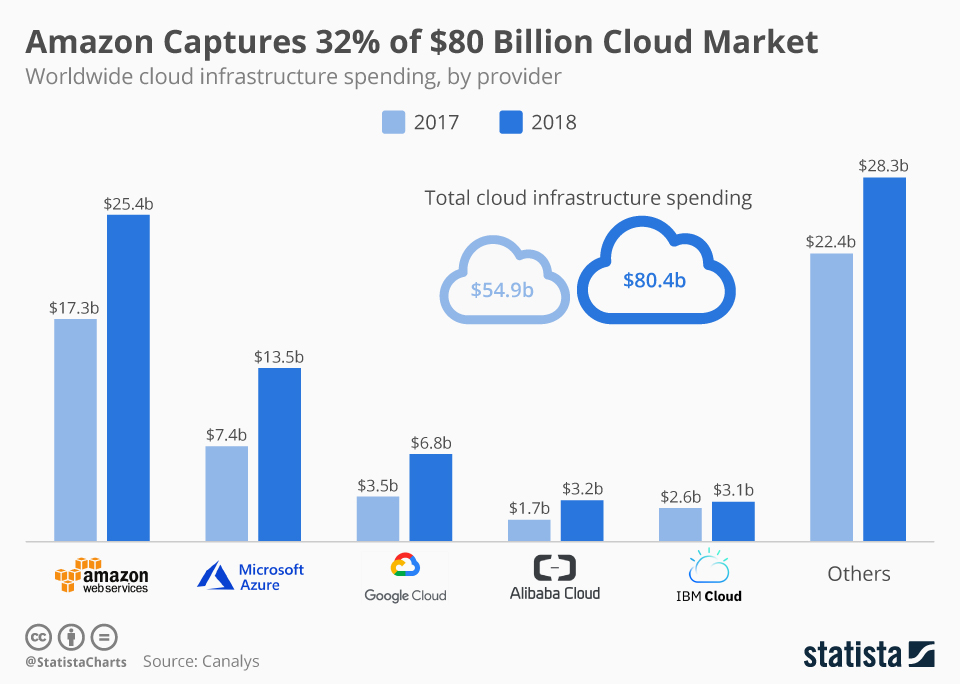
AWS brings an incredible array of machine learning and data analysis tools with several frameworks for IOT insights. Of course, it is now one of the best cloud providers that offer themselves as a general-purpose IoT back-end. However, AWS is the first to pull these elements and set the standard reasonably. Though it is difficult to sense an overall market share for AWS products, the enterprise IoT users survey rated them third among IoT platforms.
Amazon’s IOT offerings focus heavily on back-end storage, general and analysis management of the data that came from IoT implementations. So, people will not buy sensors, networking elements or edge hardware from Amazon. But AWS will handle the data manipulation.
Cisco
Cisco didn’t have the in-house expertise for advancing its IoT portfolio, so Cisco acquired it. Also, the company is applying its networking expertise to IoT-specific issues and integrating connectivity options smoothly.
CISCO produces a networking control suite and an IOx version for edge devices and ruggedized wireless gear mainly for industrial environments. It is one of the most prominent players. It made its presence seen in major IoT market segments, including automotive, gas and oil, and healthcare. In addition, it has an active presence in many parts of the IoT stack.
Microsoft Corporation

Source
Microsoft Corporation is one of the famous tech giants that have thrown their hat in the IoT space. They use their Microsoft Azure cloud management services for creating an IoT platform to operate with billions of IoT assets. Currently, Microsoft is investing a significant amount in IoT research. Moreover, it is a leading company of this technology.
Conclusion
The companies mentioned above offer different solutions that help businesses explore revenue streams and solve digital challenges with IoT technology.
