
by Linda Rawson | Apr 9, 2019 | Air Quality, Federal Government Contracting

GSA Schedule 66 Announcement
DynaGrace Enterprises, a WOSB, professional services company has been awarded the GSA Schedule 66 – Scientific Equipment and Services Schedule Contract. The first women-owned firm in Utah to be a vendor on that prestigious GSA schedule.
It’s more than DUST. The employee who works in a dusty environment is exposed to a deadlier form of dust, silica. The average person is also exposed to a massive amount of air pollution that you can see with the human eye. DynaGrace Enterprises helps people breathe cleaner air by providing products and services for monitoring respirable dust particles and visible emissions.
“This federal government contracting vehicle enables us to reach more occupational health and safety managers as well as those agencies concerned with worker safety and air quality regulation and compliance, “ stated Linda Rawson, President, and Founder of DynaGrace Enterprises.
The arduous process of getting the prestigious GSA schedule was made easier by utilizing the State of Utah’s, Governor’s Office of Economic Development program of offering a referral to LSI’s GSA consulting assistance from PTAC. Linda Rawson states, “LSI was another member of our team, and I consulted with them often to ensure I was answering the questions appropriately.”
The respirable dust products surround the Nanozen DustCount 8899, a real-time, wearable, respirable dust monitor. Instantaneous reporting makes compliance with OSHA Respirable Crystalline Silica

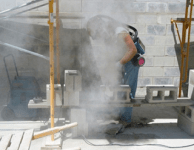
Master Sgt. Donnie Bogan saws cutting lines in concrete, licensed under the terms of the United States Government Work.
standard easy. The Nanozen DustCount 8899, a real-time, wearable, respirable dust monitor detects air particulates down to a microscopic level in real-time.
OSHA has recently changed the Respirable Crystalline Silica Permissible Exposure Limit (PEL) to 50 mg/m3 for 8 hours and the Action Limit to 25 mg/m3. Employers need to evaluate and control the exposure limit for their employees.
One way to do that is to have a worker wear the DustCount, for 8 hours and obtain the Total Weight Average (TWA). The rugged DustCount fits into a vest pocket or clips on a belt. The results can be analyzed real-time and downloaded at the end of the shift. The filter is then sent to an AIHA approved lab to be analyzed for silica levels.
The second product line surrounds visible emissions and offers a Laboratory Information Management Systems (LIMS) called Digital Opacity Compliance System (DOCS) by Virtual Technology LLC out of Arizona. The system can determine plume opacity from smoke, soot, and visible dust. Some of these are necessary, but the software helps determine how much is too much. The software ensures EPA Method 9 compliance and EPA Method 22 for the frequency of emissions.
Scientific professional services are also available including Data Security Analyst, Software Systems Engineer, Technical Writing and Editing, Technical Support and Visible Emission Consulting.
Linda Rawson passionately says “Let’s face it. We don’t want anybody years from now spitting a piece of their lung on the sidewalk from silicosis. We are deeply concerned about the air quality of the nation. We are concerned with the air people breathe both at work and in their daily lives and want to make sure the air is safer.”
Customers can learn more about DynaGrace Enterprises by visiting the company’s website at DynaGrace.com or by calling the company directly at 888-676-0058. DynaGrace Enterprises will be at the AIHA conference in the Nanozen booth #1502.
Read the official press release here -> DynaGrace Enterprises Awarded the GSA Schedule 66 – Scientific Equipment and Services
by Linda Rawson | Mar 13, 2019 | Industrial Hygiene
Construction dust as the name implies is referred to as dust generated on construction sites; and is of various types. Dust can be dirty as well as causes nuisance. However, most importantly, it can also cause severe health damage, sometimes with long-term consequences.
Types of Dust

Silica Dust Particles
There are three main types of dust:
- Silica dust: Silica is a natural mineral found in sand, sandstone, and granite in large quantities. Many building materials such as concrete and mortar are also commonly seen. During many everyday tasks such as cutting, drilling, and grinding, silica is broken into a very fine dust (also known as Respirable Crystalline Silica or RCS). Silicium dust is often called silica.
- Non-silica dust: Where silica is not found or present in meager quantities, there are some construction products. Gypsum, cement, calcareous, marble and dolomite are the most common. When cutting things like bricks, this dust is also mixed with silica dust.
- Wood dust: Wood is widely used in building and is found in two primary forms: softwood and hardwood. Wood-based products, including MDF and chipboard, are also commonly used.
Causes of Dust
Building workers have a particularly high risk of developing health problems due to prolonged exposure to high dust levels. OSHA’s silica standard for general industry and maritime took effect June 23, 2018. The agency estimates that 2.3 million workers are exposed to silica dust annually.
Related Article OSHA Published Silica Standard FAQ
On a construction site, there are many routine tasks that can produce high dust levels:
Sandblaster
- Cutting paving blocks, curbs, and flags.
- Chase concrete and mortar raking.
- Sweeping dry area of the site.
- Cutting roof tiles.
- Concrete scabbling or grinding or other construction materials.
- Soft demolition of strips.
- Woodcuts and sanding.
- Sanding taped and covered plasterboard joints.
The 2002 regulations of Health Hazardous Substances Control (COSHH) regulate activities that may expose workers to building dust. It provides employers with a legal obligation to prevent or adequately control the exposure of workers and requires risk assessment and control and control.
Health risks
Dust builds up in the lungs and, while the effects may not be immediately apparent, exposure to high levels of dust can lead to permanent damage to the lungs and airways over a prolonged period. Some of the diseases mostly affect construction workers are related to dust include lung cancer which is silicosis. Chronic obstructive pulmonary illness (COPD) which is asthma.
Risk Assessment
There are some factors that contribute to the risks from dust: The more energy involved the work increases the risk. In a very short time, high-energy tools such as cut-off saws, grinders and grit blasters produce much dust. Depending on how close the work area is, dust will build up. The longer the work takes, the more dust. Doing the same work day after day increases the risk of hazardous dust exposure.
For a full copy of the General Industry FAQ please see this link -> https://www.osha.gov/dsg/topics/silicacrystalline/generalindustry_info_silica.html

by Linda Rawson | Feb 25, 2019 | Business, Industrial Hygiene

DGE Announcement of Nanozen DustCount
DynaGrace Enterprises today announced that they are expanding their product line to include state-of-the-art technology to monitor air quality. The Nanozen DustCount 8899, a real-time, wearable, respirable dust monitor detects air particulates down to a microscopic level in real-time.
OSHA has recently changed the Respirable Crystalline Silica Permissible Exposure Limit (PEL) to 50 mg/m3 for 8 hours and the Action Limit to 25 mg/m3.
Employers need to evaluate and control the exposure limit for their employees.
Related article: OSHA Publishes Silica Standard FAQ
One way to do that is to have a worker wear the DustCount, for 8 hours and obtain the Total Weight Average (TWA). The rugged DustCount fits into a vest pocket or clips on a belt. The results can be analyzed real-time and downloaded at the end of the shift. The filter is then sent to an AIHA approved lab to be analyzed for silica levels.
“A problem in the workforce is getting the worker to wear a mask while working in environments heavily laden with dust. The respirator masks are hot and uncomfortable and lower productivity in an industrial environment,” stated Linda Rawson, President, and CEO of DynaGrace Enterprises. “Determining what work processes have high exposure and requiring the worker to wear the mask only during those periods is a win-win scenario for both the employer and the worker.”
DynaGrace Enterprises accepted the opportunistic challenge from Nanozen because of their passion for Air Quality and the safety of the industrial worker.
Products, like the Nanozen DustCount 8899, are making a difference. In 2017 OSHA reported 45,800 fewer nonfatal injury and illness cases compared to the 2016 statistics reported by the Survey of Occupational Injuries and Illnesses (SOII). The CDC age-adjusted statistics report that the death rate for Silicosis during the period of 2005-2014, went from 1.65 Male, .03 Female, per million in 2005 down to .69 Male, .01 Female in 2014. The statistics should only get better because of the new OSHA standard.
Linda Rawson passionately says “Let’s face it. We don’t want anybody years from now spitting a piece of their lung on the sidewalk from silicosis.”
Customers can learn more about DynaGrace Enterprises by visiting the company’s website at DynaGrace.com or by calling the company directly at 888-676-0058. DynaGrace Enterprises will be at the AIHA conference in the Nanozen booth #1502.
Read the Press Release here ->DynaGrace Enterprises is Helping People Breathe Cleaner Air

by Linda Rawson | Feb 22, 2019 | Industrial Hygiene

Two male industrial workers who were inside a West Virginia ceramics factory, Public Domain Picture by CDC
From the day we’re born, taking a deep breath is something we all take for granted. Silica in an industrial environment is common place.
Adults breathe 12 – 20 times a minute when they are resting.
As humans, we take between 17,000 – 30,000 breaths a day, and the total length of the airways in our lungs is estimated to be 1491 miles (2,400 km.) The equivalent of Denver, Colorado to New York City, NY in travel! However, every breath you take has the potential to cause silicosis. Especially if you work in an environment where you are exposed to respirable crystalline silica (RCS).
What is silica?
Silica is a fundamental component of soil, sand, granite and many other minerals and is found in many places on Earth. The most common form of silica is Quartz (the other two have cristobalite and tridymite). All three forms create breathable particles when workers chip, cut, drill or grind objects containing silica.
Related article: OSHA Publishes Silica Standard FAQ
Silica, is a primary component of the Earth’s crust, is present in a wide range of industrial and non-industrial environments and consumer products (including many cosmetics and cat litter).
The breathing of the silica dust generated from these activities can have a devastating effect on health, which can cause lung cancer and silicosis.
When we talk about the dangers of silica, the word “silicosis” immediately comes to mind.
Silicosis itself tends to be linked to mining. The weakening lung disease, caused by the inhalation of crystalline silica dust, has flourished in medical, political and social policy responses and has captured the public imagination expressed in popular culture, from mining ballads to representative art.
There are legitimate reasons for this – not least the massive harm to the lungs caused by the disease. Silicosis has precedence of being a dangerous occupational disease and has made its mark in the mining industry in the global economy.
However, when it comes to silicosis, the mining industry is not the full story, and silicosis is not the primary disease when it comes to silica risks.
Since the 1990s, medical science has re-evaluated the potential role of silica in triggering inflammatory diseases, autoimmune diseases which include systemic lupus erythematosus, scleroderma, rheumatoid arthritis, and sarcoidosis. Although it was previously thought to be harmful only when inhaled in the form of dust, the question now arises whether exposure to silica in other forms can also be risky.
The road from safety to occupational health, industrial hygiene and well-being may be a long and winding road, but as practitioners, we get the hierarchy of control measures. If we all took the time to consider RCS and whether our existing control measures were designed to ensure routine maintenance and control of RCS, we would each contribute to reducing the number of people dying of silicosis and keep the worker safe.
References:
https://rospaworkplacesafety.com/2016/06/29/every-breath-you-take-a-brief-history-of-silica-and-silicosis/
http://www.sciencespo.fr/silicosis/content/silica-and-silicosis-history

by Linda Rawson | Feb 11, 2019 | Industrial Hygiene
OSHA put out a Request for Information (RFI) to ask for additional information regarding the respirable crystalline silica standard. OSHA revised the silica standard March 25, 2016, and launched an industry compliance effort on September 23, 2017, with full enforcement of the October 23, 2017 standard.

The U.S. Army Corps of Engineers working on Folsom Damn. Photo allowed from Public Domain by US.
The 2016 OSHA rule lowered the Permissible Exposure Limit (PEL) to 50 micrograms per cubic meter (µg/m3) of air as an 8-hour Time Weighted Average (TWA) in general industries. OSHA considers that level to be technically achievable for affected industries. In construction, OSHA put an Action Level (AL) of 25 µg/m3 over 8-hour TWA, among other requirements. The original OSHA standard established in 1971 had a PEL of 250 µg/m3 in the construction industry and 100 µg/m3 in general industry.
Related article: OSHA Publishes Silica Standard FAQ
The OSHA standard for the construction industry is strict, and the criteria are listed in Appendix I: OSHA Respirable Crystalline Silica Standard for Construction. Inside the appendix is a table of engineering controls, work practices, and respiratory protection specified for everyday construction job tasks that possibly release respirable crystalline silica. Employers that comply with the methods defined in “Table 1– Specified Exposure Control Methods When Working with Materials Containing Crystalline Silica ” are exempt from the PEL or demands for monitoring of employee worker direct exposures. However, employers should be willing to protect workers.
OSHA Seeking Additional Information
OSHA has issued the RFI to solicit comments from industry on Table 1. OSHA described its plan in the Fall 2018 schedule of governing and deregulatory actions. Regarding the Fall of 2018 agenda, OSHA said it had an interest in 3 details:
- The efficiency of control determines not consisted of for tools and jobs listed in Table 1;
- Tasks and even devices including exposure to respirable crystalline silica that is not noted in Table 1; and
- The performance of dirt control methods in limiting employee exposures to respirable crystalline silica when executing those procedures.
In evaluating the responses to the RFI, OSHA will determine if alterations to Table 1 are ideal and needed.
Lower PEL Full of Controversy
Regarding the OSHA 2016 rule, the development of lower PEL was subject to controversy, debatable and probably would be challenged in federal court.
Nevertheless, December 22, 2017, the three-judge panel of the UNITED STATES Court of Appeals in Washington DC upheld the OSHA rulemaking with one exception, finishing a challenge by North America’s Building Trades Union and US Chamber of Commerce. An agreement was made that OSHA’s medical removal requirements were arbitrary and instructed the agency to reconsider them.
What Should Employers Be Aware Of?
Employers that comply with the PEL are not subject to exposure assessment. Construction industry employers should focus their efforts on the exposure control methods. The exposure control methods are defined in Table 1 of the OSHA standard, however, methods not included in the standard should be avoided. If an employer is not properly implementing the control methods OSHA will issue citations.
Have your employees wear a real-time DustCount 8899 – Respirable Dust Monitor – Click Here to Learn More
According to Bloomberg Environmental, a Virginia construction company was issued five citations for respirable crystalline silica violations totaling $304,130. In other words, the fines could be the most substantial fines ever under the new silica standard.
For a full copy of the General Industry FAQ, please see this link -> https://www.osha.gov/dsg/topics/silicacrystalline/generalindustry_info_silica.html
If you are an employer with respirable crystalline silica standard potential issues, you may want to monitor the RFI and provide comments and data to OSHA regarding the standard. Refer to the RFI here ->https://www.reginfo.gov/public/do/eAgendaViewRule?pubId=201804&RIN=1218-AD18

